Showing posts with label graffiti. Show all posts

February 25, 2014

The Elemental Session: Spray Can Kidz

The memebers of Nuu Elementz and friends held its second elemental discussion this past Friday on the topic of the first element of hip-hop, graffiti.

The dictionary term for graffiti means writing or drawings on public walls or services.

The term graffiti has been used since the ancient times in Greece and Rome. The first known example of graffiti is in ancient Greece Ephesus, modern day Turkey. Figure drawings can also be found in the catacombs of Rome.


Ancient graffiti (in red) is covered by tourists' markings inside Rome's Colosseum.
Today, many see graffiti as vandalism or scribbles on the wall. But graffiti is an art. It is an expression.

Graffiti was used to express political statements, or to use as an art canvas.

In the 60s, a big wave of graffiti spread opposing the Vietnam War. Black Panther advocates tagged 'Free Huey' on the walls and against former President Nixon.
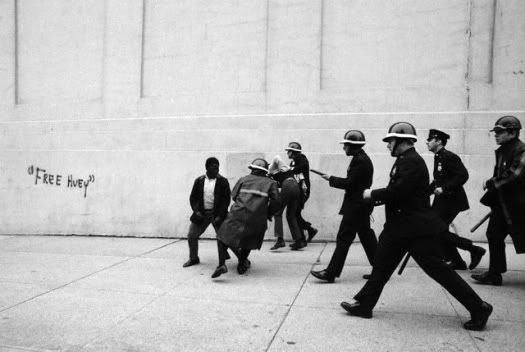

Graffiti on a campus wall of the City College of New York reads 'Free Huey', a reference to Black Panther leader Huey Newton (1969)
In the 70s, graffiti was used to warn people of gang territory.

"My mom let me draw on the walls in my room. I chose the colors for my walls," said Rob Drake (@Rob_Yhungfrom Miami, who was 11 years old at the time. "I picked yellow and wrote over it with a black sharpie." He said his mother influenced him with a lot of art. "I wrote my calendar, to-do lists, poetry, everything on my wall."

Jocelyn Brantley (@18UntoldStories) from Harttford, Conn. started appreciating graffiti more when she noticed the art park in Tallahassee.


Railroad Square Park in Tallahassee, Fla.
Elon Matthews (@LonSoCal) grew up in Los Angeles. "When you drive through the neighborhoods, you'll see a lot of different writings." He said that if a gang tagged a wall, it signified that somebody is going to die. "Gangs took force."

Patrice Washington from Orlando said if she could write graffiti right now, she would draw a sunflower. "I love sunflowers. I'll draw it to match my personality."


Jimmy Dickson photo.
Candy Churchill (@Pr1s5yHippie) from Chicago said she would use graffiti to write on court houses in order to bring awareness on certain topics.

There are many differences between east coast graffiti and west coast graffiti. In the east coast, graffiti is more animated with many colors. In the west coast, graffiti is strictly defined.
Both coast writings have to do with gang affiliation.


Writer, Bloch ESE writing West coast style.
Graffiti shows different messages of oppression, community voice, and history. Murals in different areas where urban communities will allow you to remember the people who have come through that neighborhood.

Graffiti is a way to communicate ideas.

"A group of African American students participated in mass graffiti to announce the racism issues going on at their school," said Candy.

You will notice graffiti because it is easy to pick up on. Graffiti is used more for an artistic expression than a criminal act.

Rose Marshall from Tallahassee, Fla. said on the way to the beach in Pensacola there is a bridge filled with graffiti that people are allowed to tag. "It's been there for 50 years or so."

Graffiti is usually seen in urban areas but it has expanded to the suburbs as well. The green electric boxes are usually always tagged with graffiti. "I've seen graffiti on monorails in Miami," said Quint Wilson (@_QTarantino) from Miami.

Jocelyn said the most interesting place she has seen graffiti was on the floor.

You will notice graffiti in places difficult to reach. Elon said that the artists use a grapeline seat. "You strap yourself to the seat and use your upper body strength to go over the water under a bridge and write."

Graffiti depends on social change.

"Our parents generation couldn't do what we can. We're rebellious, they weren't allowed to be," said Rick Moore (@RickiRich) from Toronto.

Graffiti has come a long way from its original roots. Below are a few writings around Tallahassee.


February 19, 2014

Color your favorite gangsta rapper

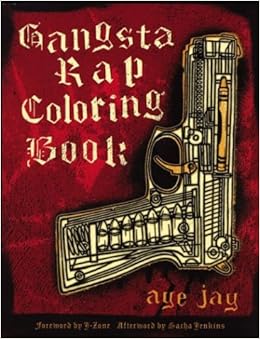
Created by artist Aye Jay, the Gangsta Rap Coloring Book presents 48 icons of rap. You'll recognize the most popular gangsta rappers from hip-hop in a series of images in thick black lines. The 'iconic' coloring book was an underground hit. Aye Jay eventually expanded the book from 20 to 48 pages.

Color your favorite gangsta rapper.
Aye Jay also has a graffiti coloring book. He got the permission from artists to redraw their pieces to form as a coloring book.

The cover of the graffiti coloring book.
You may find both books on Amazon for about $8! Click links:
Gangsta Rap Coloring Book
Graffiti Art Coloring Book

Graffiti: The Good, the bad, and the ugly

Graffiti was mainly used by political activists to make statements and by street gangs to mark territory.
In Los Angeles during the 1930s, shoeshine boys began tagging their street corners with their names to keep others away from their spot.

Cholo writing in L.A.
It wasn't until the late 1960s when graffiti's true identity began to form. The history of graffiti most commonly began in Philadelphia.

Cornbread is credited for graffiti's first explosion. He wrote his name all over the city.
Cornbread's most famous feats of tagging the elephant at the Philadelphia zoo.

Shortly after Cornbread made his debut, graffiti began to spread to New York in the Washington Heights section.

Taki 183 was one of the most influential graffiti writers in its history. His nickname was the alias for his name, Demetrius. He frequently tagged the subways of New York with his art. Taki's simple signature captured the attention of a reporter and an article appeared in the New York Times. He was the first New Yorker to become famous for writing graffiti. The appearance of his name sparked the public's interest and was published in a New York Times article.

His tag is short for Demetaki, a Greek alternative for his birth-name Demetrius.
The numbers in the nicknames identify the number of the street each artists lives in.

Writing started moving from the streets to the subways and became competitive. The subway system was a line of communication and a unifying element for all the separate movements. At this point, writing consisted of mostly tags and the goal was to have as many as possible.

After a while, graffiti became so popular that everyone was doing it. Writers found many unique ways to tag. They enhanced their tags with stars, flourishes, and other designs. Crowns were used by writers who proclaimed themselves as king.

The most famous tag in the culture's history was Stay High 149. He used a smoking joint as the cross bar for his "H" and a stick figure from the television series, The Saint.
Writers started to present their tags in larger scale. Larger tags drew more attention.Writers began to increase the thickness of the letters and would outline them with an additional color. This led to the development of the masterpiece.

Super Kool 23 is credited for the masterpiece. The thicker letters enhanced the name. Writers decorated the interior of the letter with designs. First with simple polka dots, later with crosshatches, stars, checkerboards.
The 50 Greatest NYC Graffiti Artists
                                                                                               Super Kool 23 was one of the first great taggers in the Bronx.
The competitive atmosphere led to the development of actual styles. Broadway style was introduced by Philadelphia's Topcat 126. These letters evolved in to block letters, leaning letters, and block busters. Phase 2 later developed Softie letters, more commonly referred to as Bubble letters. Broadway style and Bubble letters were the earliest forms of actual pieces and the foundation of many styles.

Hugo Martinez founded the group, United Graffiti Artists. It selected top subway artists from all around the city and presented their work in the formal context of an art gallery. UGA provided opportunities for exposure. The Razor Gallery was a successful effort to the artists Martinez represented.

Females began to gain attention during the early 1970s. Manhattan's Barbara 62 and Eva 62 where the most prolific. They were just as conquerable as the male writers. As with many male-dominated fields, women weren't respected as writers and were rumored to sleep around.

Barbara 62 & Eva 62 remain the most recognized of their era to date.
A new wave of creativity bloomed in the late 70s with crews like TDS, Shy 147, Rasta and more. Style wars were peaking again. It was also the last wave of bombing before the Transit Authority made the elimination of tagging a priority.

In 1980, writers started to consider other creative options. Numerous of writers flocked to art galleries to broaden their horizons.

During the mid 1980s, the writing culture changed dramatically. Due to the drug trade, firearms where available and the climate on the street was tightened. Laws restricted the sale of paint to minors and required merchants to place spray paint in locked cages. Legislation was in the process to make penalties for graffiti more severe.

After the increase in the Metropolitan Transit Authority's anti-graffiti budget. The budget paid for a total of 80,000 hours to remove graffiti. Yards and layups were ore closely guarded and new sophisticated fences where build and quickly repaired when damaged. This caused for writers to quit.

Many other writers weren't so easily discouraged. Physical strength and unity became a major part of the writing experience.

Metropolitan Transit Association spent millions on campaigns to get rid of graffiti.

On May 12, 1989, the MTA declared victory over graffiti. The MTA set a policy to remove all marked subway cars from service.

Graffiti holds a significant place in the elements of hip-hop. Graffiti represents the visual of hip-hop. Writers were as prominent like b-boys, emcees, and DJs at the party.

Graffiti still exists as a major part of the urban environment.


February 09, 2014

Graffti takes over National Railroad Museum

A new exhibit opened up at the National Railroad Museum in Greenbay, Wisconsin.

greenbaytour.blogspot.com
"From Big Boys to Boxcars: The Good & Bad of Railroad Graffiti" allows the museum to showcase professional photographs of railroad graffiti. 

The exhibit explores graffiti both as art an vandalism in a social and historical context.

postcresent.com
Graffiti originated in ancient times and is one of the four elements of hip-hop. 

The art form is somewhat controversial in modern life and railroading.

The museum is home to a Union Pacific Railroad Big Boy whose world famous name derive from graffiti.

yorkpress.co.uk
The executive director of the museum, Jacqueline D. Frank hopes the community will use the exhibit as a place to examine the fine art photography and to use as a basis of social discourse about graffiti's role in the community. 

January 19, 2014

Beiber Sippin' Sizzurp

Reports claim that Justin Beiber has been dangerously abusing illegal drugs.

CNN

One of Beiber's graffiti tags from more than a month may have been a warning of the singer's bad habit.

He tagged the words "Double Cup" with a Styrofoam cup next to it on a skateboard ramp in his backyard.

TMZ
The phrase is slang for sizzurp that is used frequently  in Hip-Hop.

The tag doesn't guarantee that Bieber uses sizzurp, but it does indicate that he is familiar with it.

January 12, 2014

Teen Graffiti To Civil War In Syria

In March 2011, protests erupted in Daraa, Syria after security forces arrested a handful of boys accusing them of painting anti-government graffiti on the walls of the school. 

Translation: "Down with Bashar."
On March 18, officials killed four people in what activists regarded as the uprising of a civil war. 
As protests spread, President Bashar Assad's forces retaliated. 

Chaos erupted as police and soldiers  were ordered to shoot.


A bombing occurred at the Syrian national security building killing four top officials, including the presidents brother and the defense minister.


President Obama intervened when he said the use of chemical weapons is crossing a "red line" and the equipment to produce the weapons were soon destroyed. 


As of now, the bickering among rebels, Islamic groups, and moderate groups against the al-Qaida-linked Islamic State of Iraq and the Levany killed nearly 500 people in a week.


It all started with graffiti. 

January 07, 2014

Banksy Graffiti Vandalized in "Sundance" Town


 Two paintings by British graffiti artist Bansky gets vandalized in a town in Utah where the Sundance Film Festival is hosted. 


The murals have become local points of pride since they appeared three years ago, and Park City police said they don't have a motive for the crime.

Banksy is a United Kingdom-based, graffiti artist, political activist, film director, and painter. 
Below is a few more of his work.


November 20, 2013

Queen's '5 Pointz' painted white


The Graffiti mecca in Queens, known around the world as one of the illest graffiti spots with piece from over 1,500 artists, 5 Pointz, is completely painted white by the owner of the building. This iconic part of Hip Hop was white painted Monday night with "police protection". These disheartening photos of the legendary graffiti building were taken by various residents and visitors of the areas. The painting of the building has caused some outrage and a vigill was held in commemoration of graffiti mecca yesterday. 5 Pointz will always be remembered. More photos below.